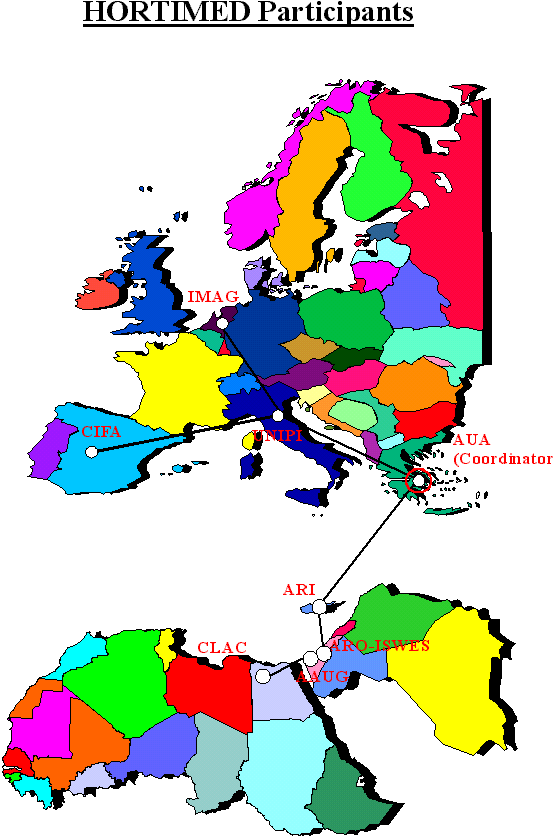
|
No |
NAME |
ABBREVIATED
NAME |
COUNTRY |
|
|---|---|---|---|---|
|
1. |
Agricultural
University of Athens |
AUA |
GREECE |

|
|
2. |
Agricultural
Research Institute |
ARI |
CYPRUS |

|
|
3. |
Central lab. For agricultural Climate
Agricultural Research Center |
CLAC |
EGYPT |

|
|
4. |
Centro
de Investigación y Formación Agraria de Almería |
CIFA |
SPAIN |

|
|
5. |
Agricultural
Research Organization, Institute of Soil, Water and Environmental Sciences |
ARO-ISWES |
ISRAEL |

|
|
6. |
Institute
of Agricultural and Environmental Engineering |
IMAG |
NETHERLANDS |

|
|
7. |
University
of Pisa
|
UNIPI |
ITALY |

|
|
8. |
Al-Azhar
University- Gaza. PA |
AAUG |
PALESTINE |
|
All partners are located in areas (both in the EU and MPCs) where the economical advantages as well as the environmental impact of intensive horticultural development are increasingly obvious. Besides this common first-hand experience, they have diverse backgrounds in the various disciplines (plant physiology; micrometeorology; ecology; agricultural engineering; information technology; management information systems; extension and training) that are needed to ensure success of such a project. Indeed, all partners will contribute significantly to nearly all sections of the project. Work package managers and task leaders have been selected on the basis of their qualifications and of their teams.
To achieve the objectives set out in this proposal, major work tasks have been identified, responsibilities delegated to specific partner groups, selected on their known experience to carry out the agreed research. To reach each specific work task goal on time, major milestones have been set, and an effective project management system agreed with specific roles of each partner and the overseeing role of the co-ordinator agreed.
AUA (Greece) has a well-instrumented laboratory to deliver Information Systems for commercial exploitation. It has conducted similar development and delivered a complete SCADA system for the on-line management of greenhouses, which is now being commercialised. The role in this proposal is to deliver a Decision Support System and an on-line control algorithm to implement the findings of this research. Therefore, this partner is mostly suitable for delivering another system for research dissemination. AUA has successfully coordinated a previous EU project (FAIR3-CT93-1603), which was driven all the way to a demonstration phase and finally to application and commercialisation. Once more, AUA is suitable to coordinate a similar project (same area - different focus).
ARO-ISWES (Israel) conducts currently research on
ventilation and evaporative cooling of greenhouse crops.
It has access to a large climate controlled greenhouse with facilities to
measure climate variables and control water application.
This facility is available for the proposed project.
CIFA (Spain) has currently activities on
plastic-house climate management (ventilation, heating, CO2 injection
....), irrigation management based on dynamic strategies to satisfy on-time
demand, open and closed substrate systems, studies on the suitability of
wastewater after tertiary treatment for re-utilization on irrigation,and
horticultural training. CIFA will subcontract part of the research work to IRTA,
Centre de Cabrils, 08348 Cabrils, Barcelona, Spain, being Dr. Juan I. Montero
the scientist responsible for the execution of the tasks. IRTA will concentrate
on the technological and physical aspects of tasks 2.2 (climate management,
movable shading development, modelling of natural ventilation and control of
humidity). IRTA will also contribute to tasks 3.1.4 (modelling of grower’s
water management) and 3.2.4 (training program based on the project outcome). By
co-operating CIFA and IRTA, the expertise on agronomy and physiology given by
CIFA will benefit from the technological and engineering expertise from IRTA,
and vice-versa. Besides, results from the project will be extended to Northern
Mediterranean areas like Cataluña, through the dissemination activities done by
IRTA.
ARI (Cyprus) has an extensive experimental record on
plant nutrition and being in the centre of the problem is well informed for
adapting plant nutrition against water salinity for a sustainable horticultural
production.
UNIPI-(Italy) has experience on salt-resistant
species (spinach, celery, etc.) and will be working on the reuse, through
bio-filtration, of salt-enriched nutrient solution from closed-loop hydroponics.
Experiments will be performed with tomato and cucumber plants grown with NFT and
using the waste nutrient solutions from these crops to cultivate celery and
spinach plants.
Two more partners, CLAC (Egypt) and AUG
(Palestine) are in the center of the problem, they are working hard against
water salinity and scarcity, and will bring the social culture of their
countries and also disseminate new results to the growers of those reagions.
IMAG (Netherlands) The presence of a Dutch partner
ensures that the considerable experience of that country with closed growing
systems is taken into account when developing water saving measures that are
suited to the needs of the Mediterranean protected horticulture.
A map of the required expertise to carry out the proposed
research and how it is well covered by the different partners is shown below.
|
Expertise
needed in the project |
P1 AUA |
P2 ARI |
P3 CLAC |
P4 CIFA |
P5 ARO |
P6 IMAG |
P7 UNIPI |
P8 AUG |
|
Decision
support software |
|
|
|
|
|
|
|
|
|
Crop
response to salinity |
|
|
|
|
|
|
|
|
|
Crop
response to climate |
|
|
|
|
|
|
|
|
|
Crop
response to nutrition |
|
|
|
|
|
|
|
|
|
Waste
water (re) use |
|
|
|
|
|
|
|
|
|
Closed
growing systems |
|
|
|
|
|
|
|
|
|
Extension
and teaching |
|
|
|
|
|
|
|
|
|
Water-saving
installations |
|
|
|
|
|
|
|
|