|
|
MACQU
RESULTS IN DETAIL
|
|
As there is a
well-known need for humidity control at the lower end of the water-uptake range,
a dynamic crop growth model (Hamer, 1997)was developed from measurements taken
during the course of the Macqu project. Simulations using a model which
predicted conditions inside the greenhouse enabled the cost benefit of de-humidification to be evaluated. A
combination of ventilation and heating proved to be the only economically viable
means of dehumidification in which the ventilation rates were constrained by
restricting the angle of opening of the ventilators. It was concluded that both visual and
internal quality parameters can be modified through environmental manipulations.
The techniques that have been developed , in course of Macqu project, can be
implemented in a management system that reacts to on-line observations. Protected
crops have a high water requirement. Irrigation
control is important to ensure that the plants needs can be met without
overwatering. Overwatering has the potential to cause environmental
damage particularly if the excess irrigation water containing fertilisers enters
the ground water system. The control
of the water supply can be used as a management tools to control crop growth and
to improve the quality of produce. A minor water requirement of the crop is for
plant growth which is typically less than 4%. However, over short periods when
transpiration rates are low the proportion of water used for storage compared to
transpiration can be high. To define an effective control strategy
it is necessary to predict how the uptake of water by the plant depends on the
climatic conditions, this can be achieved using a model. (Hamer, P.J.C., 1997).
To ensure that the crop receives adequate irrigation throughout a season under
all the environmental conditions experienced, the model must be robust, which
implies simplicity, and that any input values needed by the model must be easily
and reliably measurable. An irrigation model for greenhouse tomatoes (Hamer,
1997) was developed and validated, in course of Macqu project. Keeping the rate of water and nutrient
drainage constant in a direct feedback control system, thus ensuring the
compensation of both water and nutrient uptake by the plants, was shown, during
Macqu project, to be viable in closed growing systems with a drain flow sensor
and also in open growing systems when using a starting gully and drain flow
sensor. A tipping-bucket sensor was
used to monitor the output of the controlled system and provide the feedback
signal to the controller (Th. H. Gieling, A.J.W. van Antwerpen, J. Bontsema,
M.HM.H Bastings, 1996). The results
showed very close control of the drainage flow, keeping it constant for long
periods of time. The value of the drain water flow can be
chosen freely. It can be lowered in such a way, that only a minimal amount is
supplied, but still all the plants in the greenhouse are receiving water. In
this way, the amount of return water is minimized, giving rise to a
reduction in the amount of water that has to be cleaned before being
re-used, hence to a cost reduction. A constant drain return will also allow for
an optimal usage of connected
equipment, which close the loop, like: drain
water cleaning and re-fertilizer equipment. No harm to the plants is risked, since the controlled supply
system will act almost instantaneously and will immediately compensate any
change in drain water return. By closely matching the supply of
irrigation water to the crop requirements, the
discharge of fertilisers into the soil environment and the consumption of water
can be reduced substantially. Model based control and constant drain
return feedback control proved to be a reliable approach. It has been proved
that improvements to growing system can reduce leaching of irrigation water. An irrigation review was undertaken,
during Macqu project, which included methods for nutrient transport to the roots
and the uptake of nutrients by the roots (Gieling, Th. H, J. Bontsema, A.W.J.
van Antwerpen & L.J.S. Lukasse, 1995).
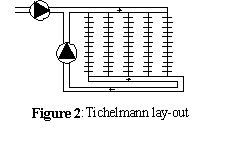
In order to improve the dynamic properties (dead time and delay times) of
water supply systems, the so-called "Tichelmann" lay-out was proposed.
The properties of this lay-out have been described in a model based on
"First Principles". It was tested by simulation and installed in a
greenhouse growing system. The
results have been disseminated at two Horticultural Engineering Shows (NTV 1995
and 1996, The Netherlands) and subsequently
the system has been widely accepted by industry. It was shown that improvements to the
water supply lay-out considerably reduced the time delays and dead times in the
supply system.
Tichelmann
lay-out description (figure 2): The outlet of
the system situates on the opposite side of the inlet . Thus, the route of the
water through the system is equal for all supply lines and the length of the
routes in the system is equal for all supply lines, the distribution of the water is nearly uniform. During Macqu an innovative dosing device
for hydroponic systems has been designed and tested. The device was filed with
Greek Industrial Intellectual Property Rights for a patent. It provides a cost
effective, reliable and of high accuracy method for mixing corrosive chemicals.
The overall system combined with a feedback loop in Macqu software accurately
controls nutrients concentrations (EC) and pH. Its main innovative feature is
that it can accept as many solution tanks as desired with very limited
additional hardware. Proportions of the different tanks are set in a simple
dialog with Macqu while total concentration (EC) and pH is control by feedback
to high accuracy. The control loop was tuned to quickly respond to system
disturbances and can maintain high accuracy in both “mixing tank systems”
and “on line mixing systems”. Given sufficient knowledge about crop
response, a management system could make an appropriate use of available tools
for manipulating indoor climate and nutrition, in order to maximize yield value.
In particular, one could choose to accept a decrease in yield, if there was a
sufficient increment in quality of the product (C. Stanghellini, W. van Meurs,
F. Corver E. van Dullemen and L. Simonse, 1997). Such a cost-benefit
weighting obviously requires some knowledge about the crop response to
both nutrition and selected factors of the climate within the house. Research in
course of Macqu project showed that: High salinity reduces yield by reducing
the influx of water to fruit. The observed reduction in fruit weight was 2.7 %
for each dS m-1 by which the salinity (EC) in the root environment exceeded 2 dS
m-1. High salinity is associated (in conditions of large water uptake) with
blossom-end rot (BER), which reduces the number of marketable fruits by 3.2% for
each dS m-1 that the EC exceeds 2 ds m-1. Depressing water uptake by imposing a
high greenhouse humidity significantly reduces the incidence of BER (C.
Stanghellini, W. T.M. van Meurs, F.G.M. Corver, E. van Dullemen and L.Simonse,
1996). However, high humidity
reduces transpiration which can produce calcium deficiency symptoms on leaves,
and this can lead to yield and quality losses in tomato fruit. Water uptake can
be increased by reducing the greenhouse humidity. The use of
alternative energy sources and energy saving methods can reduce the emissions of contaminants into the environment
and also increase energy efficiency
thus improving the competitiveness of greenhouse production. A number of techniques have been tested
to investigate energy use and cost saving methods and useful tools have been
developed under the MACQU project. Greenhouse energy use models are
practical ways to predict the behaviour of the greenhouse and to improve energy
management, and three such models were developed in this project. A dynamic greenhouse model was developed
and validated to predict the response of the greenhouse environment to the
external weather, the internal environment conditioning devices and the control
actions (Navas L.M., De la Plaza S., Garcia J.L., Luna L. and Benavente R.M.,
1996). A second model, of the step-wise steady
state type, was developed to estimate greenhouse energy needs with different
energy saving measures and to calculate the energy needs covered by conventional
or alternative energy sources (Garcia J.L., De la Plaza S., Navas L.M.,
Benavente R.M. and Luna L., 1996). This model has been included in a computer
program and the logic code produced was integrated in the MACQU program. Other models were developed for energy
and investment cost analysis with different energy sources (heat pump, solar
energy and cogeneration) and to check the experimental results, this showed that
heat pumps could be feasible under certain conditions. An approach to solving the problem of
remotely operating a complex greenhouse, designed for best use of equipment and
resources, involves the design of an end-to-end system that includes the human
operator as a critical component. Therefore the growers' intuition and
experience is allowed to intervene at different stages, and user goals can be
expressed at different levels of management, from rules about quality and yield,
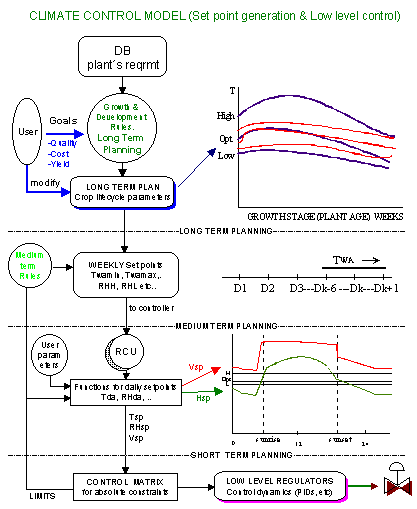
down to set-point manipulation (figure 3). The remote controller unit (RCU)
handles all of the closed loop controls for the greenhouse operation, such as
heating or ventilator degree setting, mist operation, valve setting for
irrigation and nutrient supply, etc. All RCU functions are parametric and can
autonomously do scheduling of operations, take energy saving measures etc, in
the framework of short to medium term planning. Higher level decisions, made at
the central station, are concerned with long and medium term strategies and
operator's goals, and are passed down to the RCU as parameters of reference
generating functions for real time set-point derivation.
Figure
3: Different levels of operators input and
rules manipulating adaptive set-point derivation. An energy
management rule-base is being prepared which will do off-line energy utilization
planning regarding energy availability, cost and projected energy needs, as well
as on-line energy saving, based on a diurnal reference trajectory adjustment
(figure 3). Experiments were conducted with
alternative energy sources and localised heating as an energy saving method (De
la Plaza S., Garcia, J.L., Navas, L.M., Benavente R.M. and Luna L., 1996). The
results showed that localised substrate heating could be economically feasible
in ornamentals crops (geranium, gerbera) when supplied with hot water from an
oil or gas fuelled boiler; but the feasibility of electricity was strongly
dependent on the price of the product; it was not feasible for tomato
production. A heated concrete
floor, another localised heating method, showed an energy saving up to 20%. The feasibility of this system was proved with crops having
low canopies and a high temperature requirement. Energy use analyses were carried out for
seven European locations to determine the economical applicability of the
systems related to investment costs, and fuel and electricity prices.
The use of localised heating, industrial thermal effluents and
co-generation were the best techniques to obtain a higher energy efficiency and
a reduction of environmental pollution. A system
was designed, to be “OPEN” and
with the innovative features of Virtual Variables and MACQU-native KBS, it is
possible to incorporate any new functionality without programming. The system
was successfully installed at the evaluation site (MAICH) and tested for the
period of March through June 97. The development
of a modern Control and Management system for greenhouses (N. Sigrimis, A.
Anastasiou, V.Vogli, 1997) used
recent advances in software design and development tools to provide a “no
programming needed OPEN system”. The system provides a vehicle through which
all research achievements can be immediately implemented in the field. The main
innovative features implemented to provide such a flexible system are: 1.
Functional
objects: Object oriented design not only on the
programming style but also on the “user_functionality”. A complete set of
“prime functions”, needed at the different signal processing stages
(input-processing-output), were identified and designed as independent objects.
These objects can be specified and chained to provide a “custom” higher
level function, i.e. management of supplementary lights. 2.
Virtual
variables (VV): The system starts with no
variables, other than hardware related, defined. At any time the “user” can
institute, in the field, new variables as functions of other variables. Such a
nesting has no limit (except physical memory). A rich set of function templates
(library) has been designed-in, from which the user can select his signal
processing building blocks. Polynomials, adjustable Time-Integrated-Variables,
multi-in-one-out, thresholds-decisions, timers and multi-point day_clocks, ,
hard and soft events, are some of such VVs which can be defined and used as
input to other functions. 3.
Virtual
control loops: Almost any control philosophy can
be implemented using a well defined chain of building blocks and smart virtual
variables. Non-linear PIDs, configurable output functions and functional
enable/disable switches are the tools to build control loops, which may also be
nested or cascaded. Virtual variables can implement models used for adaptive
set-point control (optimize greenhouse performance) or for a feed-forward action
(optimize loop performance). 4.
KBS-Tasks/subtasks:
Higher level management can be implemented using a Fuzzy Logic, rule based,
expert system, native of Macqu. This system provides input, output and rule
editor on line. The outputs can directly affect the greenhouse equipment or may
influence control loops, previously defined in the greenhouse computer. The
rules may refer to (consequent) tasks which are open objects including one or
more subtasks. Subtasks are the “modes” of operation of equipment drivers,
programmed in the greenhouse computer. In this way a Fuzzy Logic Controller,
native of Macqu, can interact with or overtake the control functions of the
greenhouse computer. Such a high degree of functionality needs “careful
set-up” /the present status/, or a well designed “supervisor”/macqu
evolution/.
In commercial greenhouses the relative humidity is
constantly varying and the aim of humidity control is to avoid environments
which would lead to a reduction in yield and/or quality.
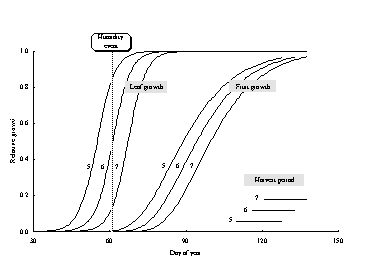
A humidity event, when leaf transpiration rate is low resulting in
symptoms of calcium deficiency occurring, influences the growth of leaves
associated with several trusses (Hamer and Belay, 1997). An event on one day can
result in the reduction of yield and quality of fruit harvested over about a
four to five week period (Figure 1). A modification of the environment at one
time of the year does not result in a return until later in the season. Crop
values change throughout a season with the lowest values when supplies are at a
peak, general in mid-season. The techniques for control must be cost-effective
so that the benefits of a control strategy in terms of yield and quality are in
excess of the costs of carrying out the dehumidification.
Figure
1: Schematic of the tomato plant growth
where 5, 6 and 7 refer to truss number
2. Irrigation and water saving
3 Nutrients supply
·
Feedfack control of the water and nutrient supply
·
“Tichelmann” lay-out
·
Hydroponic system
4. Quality
·
Quality vs nutrition
·
Quality vs climate
5. Energy conservation
·
Energy saving
·
Energy management
·
Heating technologies
6. Development of a modern Management and
control package.