
by Emmanuel N. Pitsinos
|
|
|||
|
|
| ||
|
by Emmanuel N. Pitsinos
|
|||
|
|
|
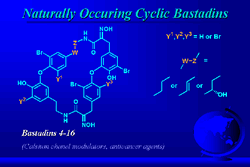
The development of a general methodology leading to efficient preparation of all members of the bastadin family of natural products constitutes a challenge; the two successful total syntheses of macrocyclic bastadins previously reported are restricted in the preparation of, symmetrically brominated, bastadin-6. Furthermore, most of the available methodology for the synthesis of diaryl ethers is either inappropriate or presents serious shortcomings for the preparation of polybrominated substrates. Thus, continuing our ongoing investigation in the area of biaryl ether natural products, we have initiated the "Bastadins" project with the objective to address the aforementioned unresolved synthetic issues and facilitate further biological studies on this class of natural products. |
|
||||||||||||||||||||||||||||||||||||||||||||||||||||||||||||||||||
|
||||||||||||||||||||||||||||||||||||||||||||||||||||||||||||||||||
|
||||||||||||||||||||||||||||||||||||||||||||||||||||||||||||||||||
|
|
|
|
|
National Scholarship Foundation of Greece (I.K.Y.)
|
Edited by Emmanuel N. Pitsinos
Prof. Elias A. Couladouros
E-Mail: ecoula@chem.demokritos.gr
Last Updated: [1-6-2000]




 Disconnection
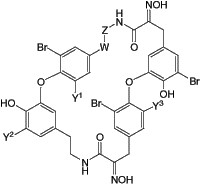
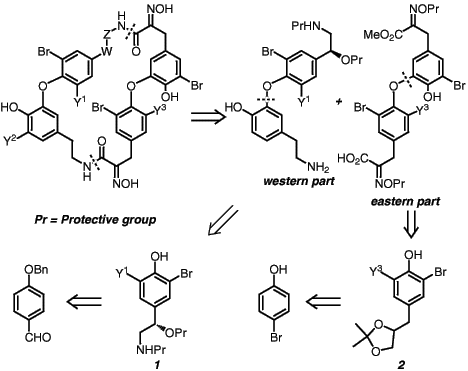
of the macrocyclic bastadins structure at the two amide bonds
leads to two biaryl ether segments: a monoprotected diamine (western
part) and a methyl diacid monoester (eastern part). Further disconnection
of these advanced intermediates at the diaryl ehter linkages and
functional group manipulation leads to an optically active hydroxylamine
and a racemic diol respectively. These key intermediates can be
prepared in multi-gram scale starting from commercially available
p-benzyloxy-benzaldehyde and p-bromo-phenol. For establishing
the correct absolute stereochemistry of key intermediate (1),
which would determine the chirality of the final product, we rely
on Sharpless' assymetric dihydroxylation methodology.
Disconnection
of the macrocyclic bastadins structure at the two amide bonds
leads to two biaryl ether segments: a monoprotected diamine (western
part) and a methyl diacid monoester (eastern part). Further disconnection
of these advanced intermediates at the diaryl ehter linkages and
functional group manipulation leads to an optically active hydroxylamine
and a racemic diol respectively. These key intermediates can be
prepared in multi-gram scale starting from commercially available
p-benzyloxy-benzaldehyde and p-bromo-phenol. For establishing
the correct absolute stereochemistry of key intermediate (1),
which would determine the chirality of the final product, we rely
on Sharpless' assymetric dihydroxylation methodology. 


